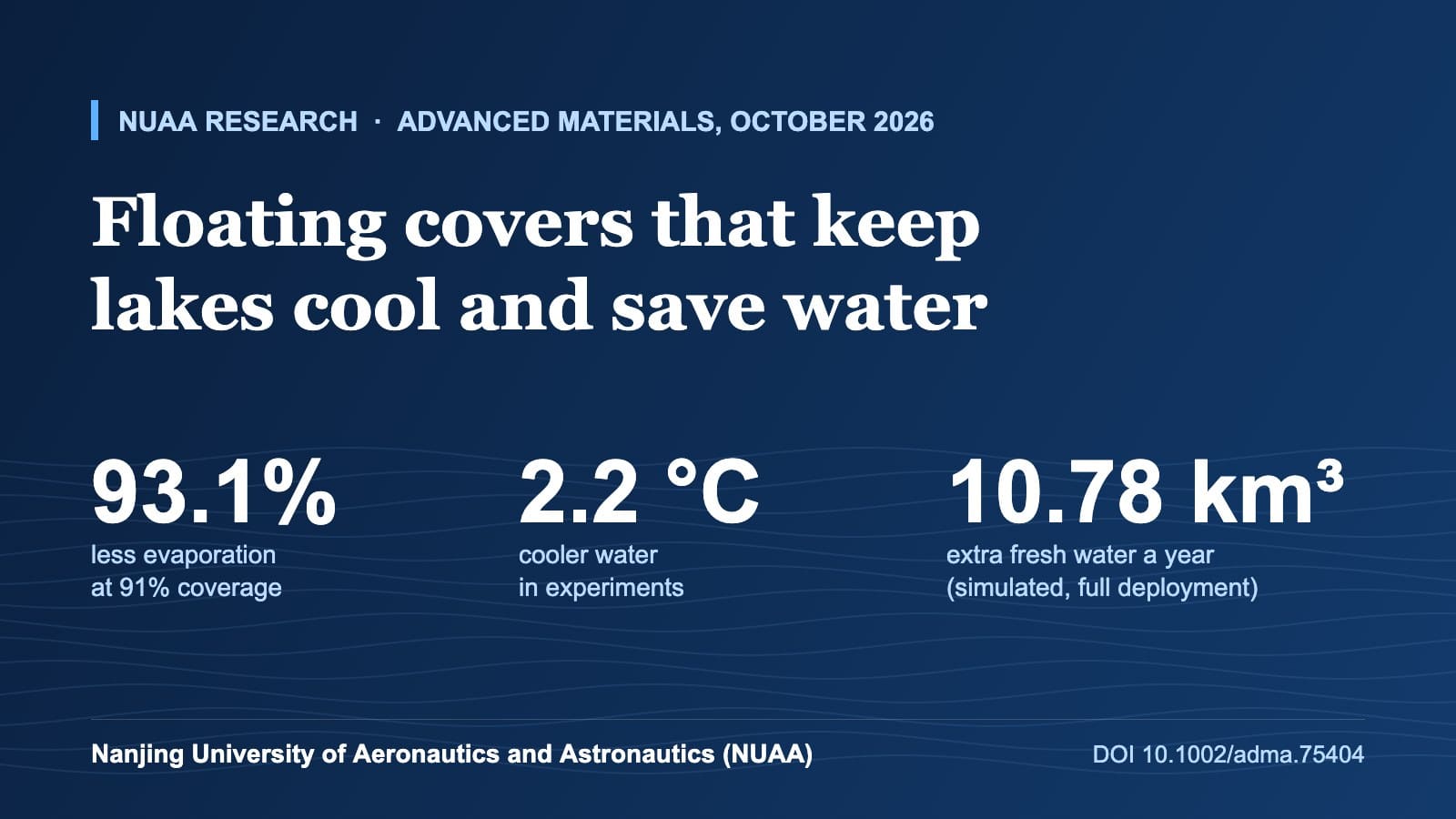
NUAA's radiative cooling floating covers kept water 2.2 °C cooler and cut evaporation by 93.1% at 91% coverage, Advanced Materials reports.
Researchers at NUAA's International Institute for Frontier Science have developed superhydrophobic radiative cooling floating covers that cool lakes and reduce evaporation. The study, "Radiative Cooling Floating Covers Cool Lakes and Suppress Evaporation", was published online in Advanced Materials on 14 October 2026 (DOI: 10.1002/adma.75404).
The covers reflect most sunlight and radiate heat to the sky as mid-infrared light. In experiments, they kept water 2.2 °C cooler and suppressed evaporation by 93.1% at 91% surface coverage. According to the authors, this is the first time a floating cover has saved proportionally more water than the area it covers.
Simulations of nine Chinese lakes showed water up to 4.87 °C cooler than with no cover. Under full deployment, the model suggests China's annual freshwater reserves could rise by 10.78 km³, about 20.9 litres per person per day.
NUAA authors include Li Xiuqiang and Academician Guo Wanlin, working with Shanghai Jiao Tong University and Nanjing University. Read the full story.