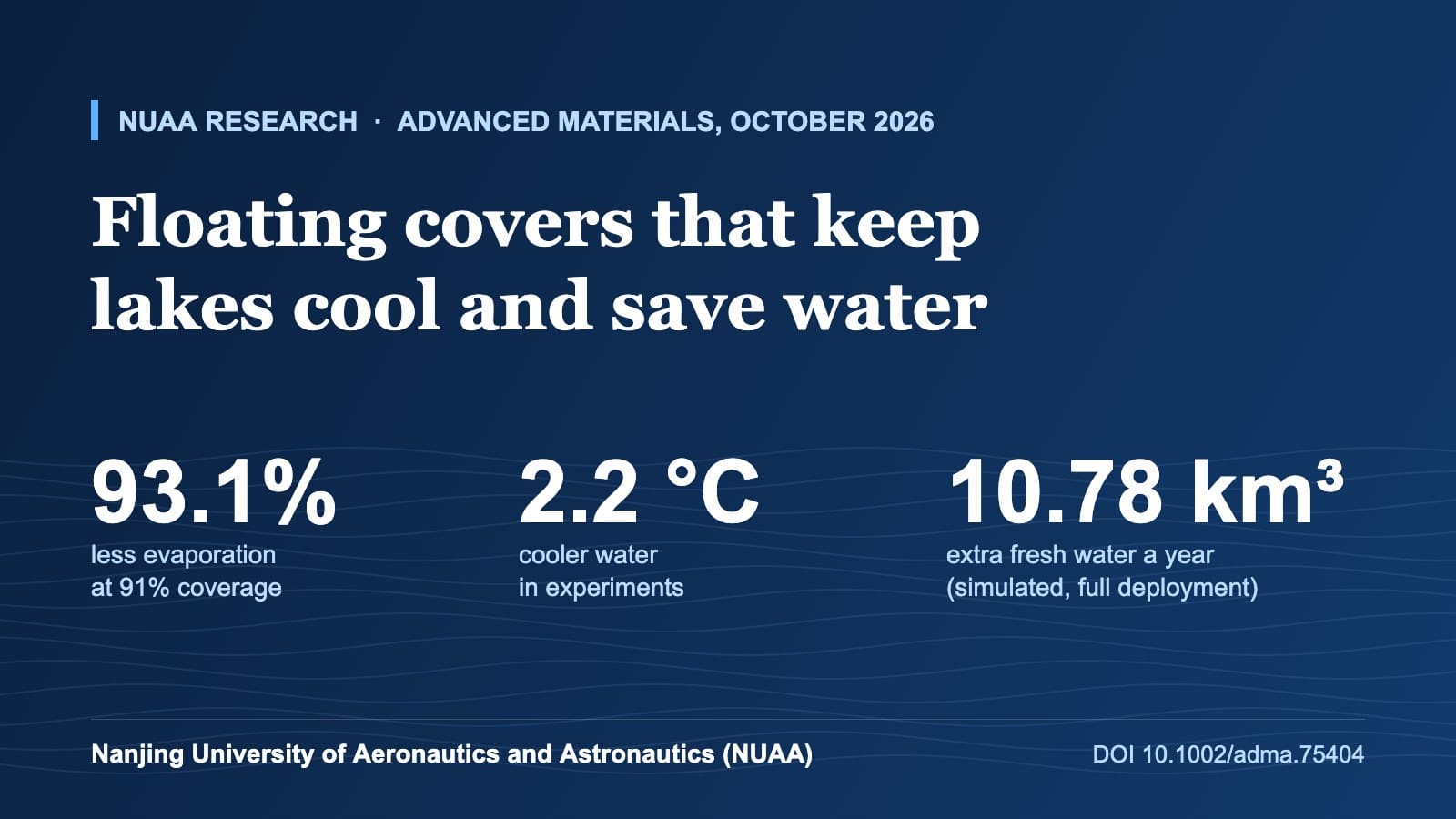
Researchers at Nanjing University of Aeronautics and Astronautics (NUAA) have developed floating covers that keep lake water cooler and stop most of it from evaporating, according to a paper published online in Advanced Materials on 14 October 2026. In experiments, the covers lowered water temperature by 2.2 °C and suppressed evaporation by 93.1% while covering 91% of the water surface.
Warmer lakes lose more water to evaporation and can suffer from low oxygen, rising salinity and loss of biodiversity. Ordinary floating covers absorb sunlight and warm the water beneath them, so they save less water than the area they cover. The NUAA design reflects sunlight and radiates heat away to the sky, so it saves proportionally more water than it covers.
Key facts
Paper: "Radiative Cooling Floating Covers Cool Lakes and Suppress Evaporation", Advanced Materials, published online 14 October 2026 (DOI: 10.1002/adma.75404).
Material: superhydrophobic radiative cooling covers that combine high solar reflectance, strong mid-infrared emission and water repellence.
Measured results: water 2.2 °C cooler than uncovered water; evaporation suppressed by 93.1% at 91% coverage.
Simulations of 9 Chinese lakes: water up to 4.87 °C cooler than with no cover and 12.44 °C cooler than with black covers.
Potential impact: in simulations of full deployment, China's annual freshwater reserves could rise by 10.78 km³, about 20.9 litres per person per day.
Team: NUAA's International Institute for Frontier Science, the Key Laboratory for Intelligent Nano Materials and Devices of the Ministry of Education, and the State Key Laboratory of Mechanics and Control for Aerospace Structures, with Shanghai Jiao Tong University and Nanjing University.
How it works
The covers are built with a multi-level structure. Their surface reflects most incoming sunlight, while the material emits heat as mid-infrared radiation that passes through the atmosphere into space — a process called radiative cooling. A superhydrophobic (water-repellent) surface keeps the covers clean and floating. According to the authors, this is the first time a floating cover has saved more water, relative to the area it covers, than a perfect blocking layer would.
The paper's authors are Hafiz M. Asfahan, Jia Siyuan, Syeda Mishal Zahra, Li Xiuqiang and Academician Guo Wanlin of NUAA, with Xu Zhenyuan of Shanghai Jiao Tong University and Zhu Jia of Nanjing University.
What this means for international students
This research tackles water security, a challenge shared by many countries in South Asia, the Middle East and Africa — and it was carried out by an international team at NUAA. Students interested in materials science, energy and the environment can explore NUAA's programmes or find a supervisor.
Frequently asked questions
What are radiative cooling floating covers?
They are floating sheets that reflect sunlight and radiate heat into the sky, so the water underneath stays cooler. NUAA's version is also water-repellent, and in tests it cooled water by 2.2 °C and cut evaporation by 93.1% at 91% surface coverage.
How much water could the covers save?
In the team's simulations of nine Chinese lakes under full deployment, China's annual freshwater reserves could rise by 10.78 km³, equivalent to about 20.9 litres per person per day. These are model estimates, not measured savings.
Where was this research published?
The study was published online in Advanced Materials on 14 October 2026 (DOI: 10.1002/adma.75404) by researchers from NUAA, Shanghai Jiao Tong University and Nanjing University.