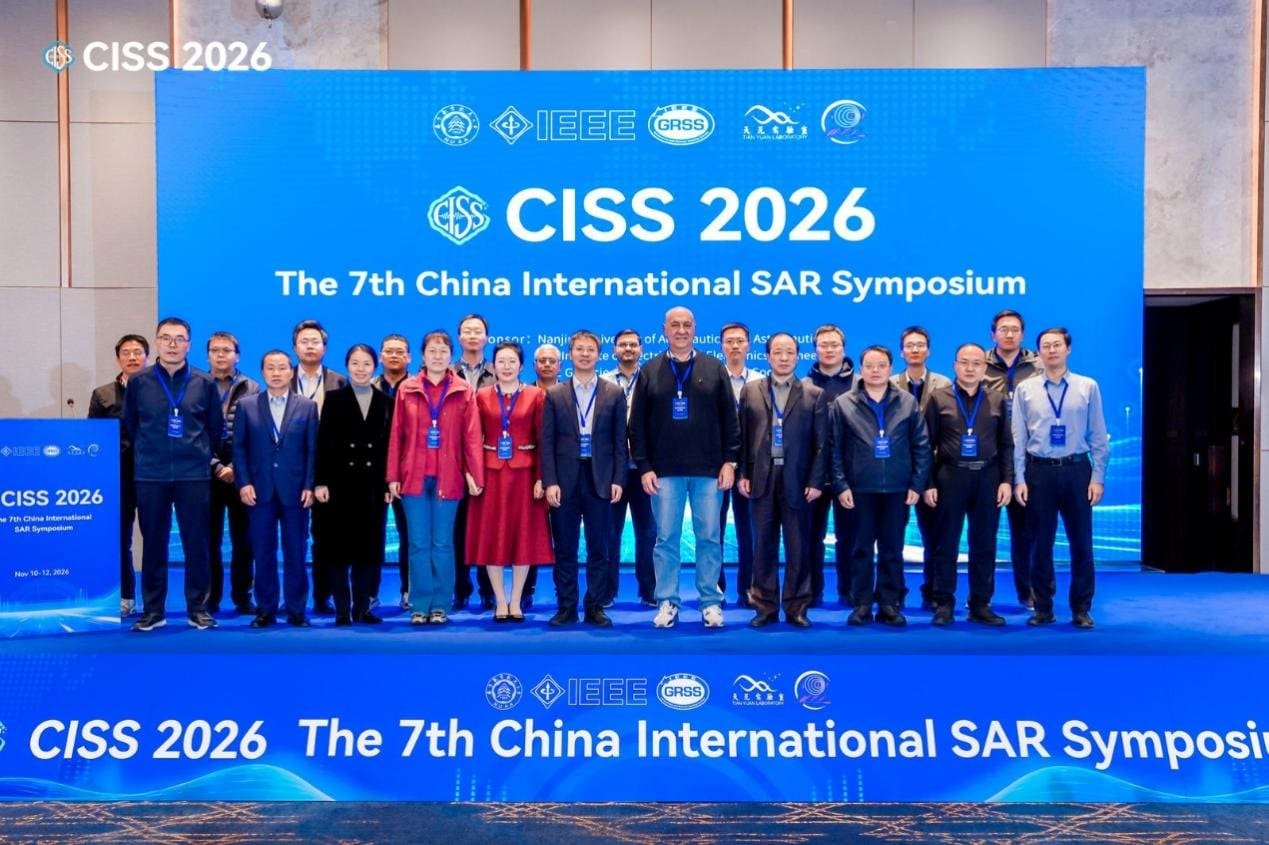
Nanjing University of Aeronautics and Astronautics (NUAA) co-hosted the 7th China International SAR Conference (CISS2026) in Nanjing from 10 to 12 November 2026. Researchers and engineers met for three days to share new work on synthetic aperture radar (SAR), a technology that produces detailed images of the Earth from satellites and aircraft.
Why it matters: SAR sends out microwave signals and builds images from the echoes, so it can see through cloud and work at night. That makes it a core tool for land surveys, disaster monitoring and ocean observation. CISS, founded in 2018, is dedicated to SAR technology and its uses. This year's programme linked SAR with microwave photonics and artificial intelligence, two fields where NUAA has active research groups.
Key facts
Dates and place: 10–12 November 2026, Nanjing, China.
Organisers: NUAA and the Shanghai Institute of Satellite Engineering, with technical support from the IEEE and the IEEE Geoscience and Remote Sensing Society (GRSS).
Edition: the 7th CISS. The series began in 2018.
Programme: 8 invited keynote talks, followed by parallel sessions over 3 days.
Topics included SAR systems, intelligent remote-sensing image processing, microwave photonics and distributed radar imaging.
Selected best papers were recommended to the journal IEEE Geoscience and Remote Sensing Letters (GRSL), and best-paper awards were presented at the closing ceremony on 12 November.
What happened
Professor Pan Shilong of NUAA chaired the opening ceremony on 10 November. Professor Alejandro C. Frery of Victoria University of Wellington, New Zealand, gave the opening address, and NUAA President Jiang Bin welcomed participants. President Jiang said NUAA has research platforms such as the Key Laboratory of Radar Imaging and Microwave Photonics of the Ministry of Education, and that microwave photonics opens new ways to improve radar performance.
Keynote speakers came from universities and research institutes including Beijing University of Posts and Telecommunications, Northwestern Polytechnical University, Beihang University, Beijing Institute of Technology, Xi'an Jiaotong University, the Shanghai Institute of Satellite Engineering and NUAA. Their talks covered trustworthy intelligent analysis of satellite remote-sensing images, generating SAR images from optical data, millimetre-wave SAR, 3D imaging with groups of drones carrying SAR, and fast high-resolution image formation.
The conference steering committee also met to review this year's paper selection and to choose the host and venue of the next edition.
What this means for international students
Radar imaging, remote sensing and microwave photonics are taught and researched at NUAA's College of Electronic and Information Engineering. Students interested in these fields can explore degree options on the NUAA programmes page and look for a research group on Find a Supervisor. Applications for the March 2027 intake are open at nuaa.apply.wiseadmit.io.
Frequently asked questions
What is CISS2026?
CISS2026 is the 7th China International SAR Conference, a meeting on synthetic aperture radar technology and its uses. It took place in Nanjing from 10 to 12 November 2026. NUAA and the Shanghai Institute of Satellite Engineering organised it, with technical support from the IEEE and the IEEE Geoscience and Remote Sensing Society.
What is synthetic aperture radar used for?
Synthetic aperture radar (SAR) builds high-resolution images of the ground from microwave echoes, so it works at night and through cloud. According to NUAA, it is a core Earth-observation technology for land surveys, disaster monitoring and ocean observation. Satellites, aircraft and drones can all carry SAR instruments.
Can international students study radar imaging at NUAA?
Yes. NUAA runs research in radar imaging and microwave photonics, including a Ministry of Education key laboratory in this field. International students can apply to related bachelor's, master's and PhD programmes taught at NUAA. The Find a Supervisor page on the NUAA international admissions site lists research groups and contact details.
Sources: NUAA News (16 Nov 2026)