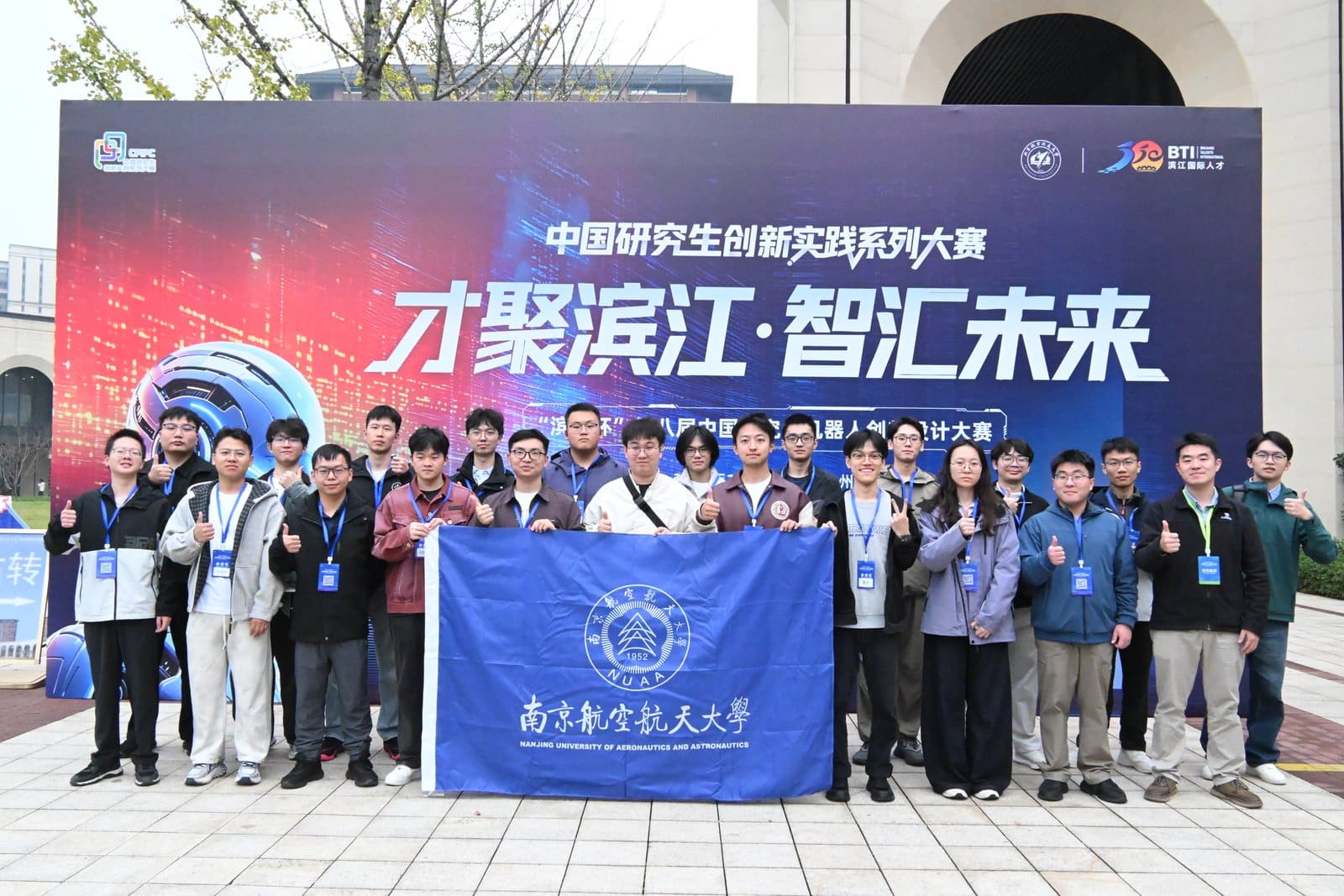
Graduate students from the College of Mechanical and Electrical Engineering at Nanjing University of Aeronautics and Astronautics (NUAA) won 10 national awards at the 8th China Graduate Robot Innovation Design Competition. The national final was held in Hangzhou, and NUAA reported the results on 13 November 2026. All 10 NUAA projects that reached the final won a prize.
Why it matters: This year's competition drew 1,509 teams from 309 universities and research institutes. NUAA's teams won 1 first prize, 4 second prizes and 5 third prizes, which the college says is its highest number of awards so far. The winning projects deal with real problems: repairing large sculptures, protecting workers on ladders and helping patients regain use of their arms.
Key facts
Competition: the 8th China Graduate Robot Innovation Design Competition, organised by the China Academic Degrees and Graduate Education Association.
Hosts: Beihang University and its Hangzhou Innovation Institute. The national final took place in Hangzhou.
Scale: 1,509 teams from 309 universities and institutes, competing in 7 tracks and 9 topic areas, plus a special humanoid-robot contest.
NUAA result: 10 finalists and 10 awards (1 first prize, 4 second prizes, 5 third prizes).
First prize: an adaptive robot that flies to large sculptures, attaches to the wall and carries out surface repair. Supervisor: Ji Aihong.
What happened
The first-prize team, BR Robot Team, built a robot for repairing the outer surfaces of large sculptures. According to the team, the robot flies to the work site, uses sensors to guide itself onto the surface and holds on firmly while it sands and repairs it. The design tackles three common problems for robots: reaching high places, fitting closely to a surface and staying steady while working. The team members are Yi Gu, Tian Chengrui, Fan Jilei, Jin Yihang and Xu Youzhi.
Among the second-prize projects, one team built a wearable robot that hooks and unhooks a safety rope for workers climbing vertical ladders, so they stay protected the whole time. The robot combines a light rope-driven arm with a self-locking hook and vision and motion sensors. Another team built a reconfigurable upper-limb exoskeleton that helps patients with arm impairments during rehabilitation and with daily tasks such as eating, drinking and picking up objects. A third team developed a two-finger system worn on the wrist. It has 6 degrees of freedom (independent directions of movement) and fingertip force sensors, and it is designed to make up for the stiffness of spacesuit gloves during work outside a spacecraft.
What this means for international students
Robotics, intelligent manufacturing and human-assistive devices are core research areas in NUAA's College of Mechanical and Electrical Engineering. International master's and PhD students can join this kind of project-based research. Browse the programmes page or find a potential supervisor through Find a Supervisor.
Frequently asked questions
How did NUAA do at the 2026 China Graduate Robot Innovation Design Competition?
NUAA's College of Mechanical and Electrical Engineering sent 10 projects to the national final of the 8th competition in Hangzhou, and all 10 won awards: 1 first prize, 4 second prizes and 5 third prizes. The competition attracted 1,509 teams from 309 universities and research institutes across China.
What robot won the first prize for NUAA?
The first prize went to the BR Robot Team, supervised by Ji Aihong. Their robot can fly to large sculptures, attach itself to the surface under sensor guidance and stay stable while it sands and repairs damaged areas. It is designed for high, hard-to-reach surfaces that are difficult for traditional robots.
Can international students study robotics at NUAA?
Yes. NUAA's College of Mechanical and Electrical Engineering offers master's and PhD study in mechanical engineering, including robotics and intelligent manufacturing. International students work in research teams with faculty supervisors. Applications for the March 2027 intake are open through the NUAA international admissions website.
Sources: NUAA College of Mechanical and Electrical Engineering (13 November 2026)