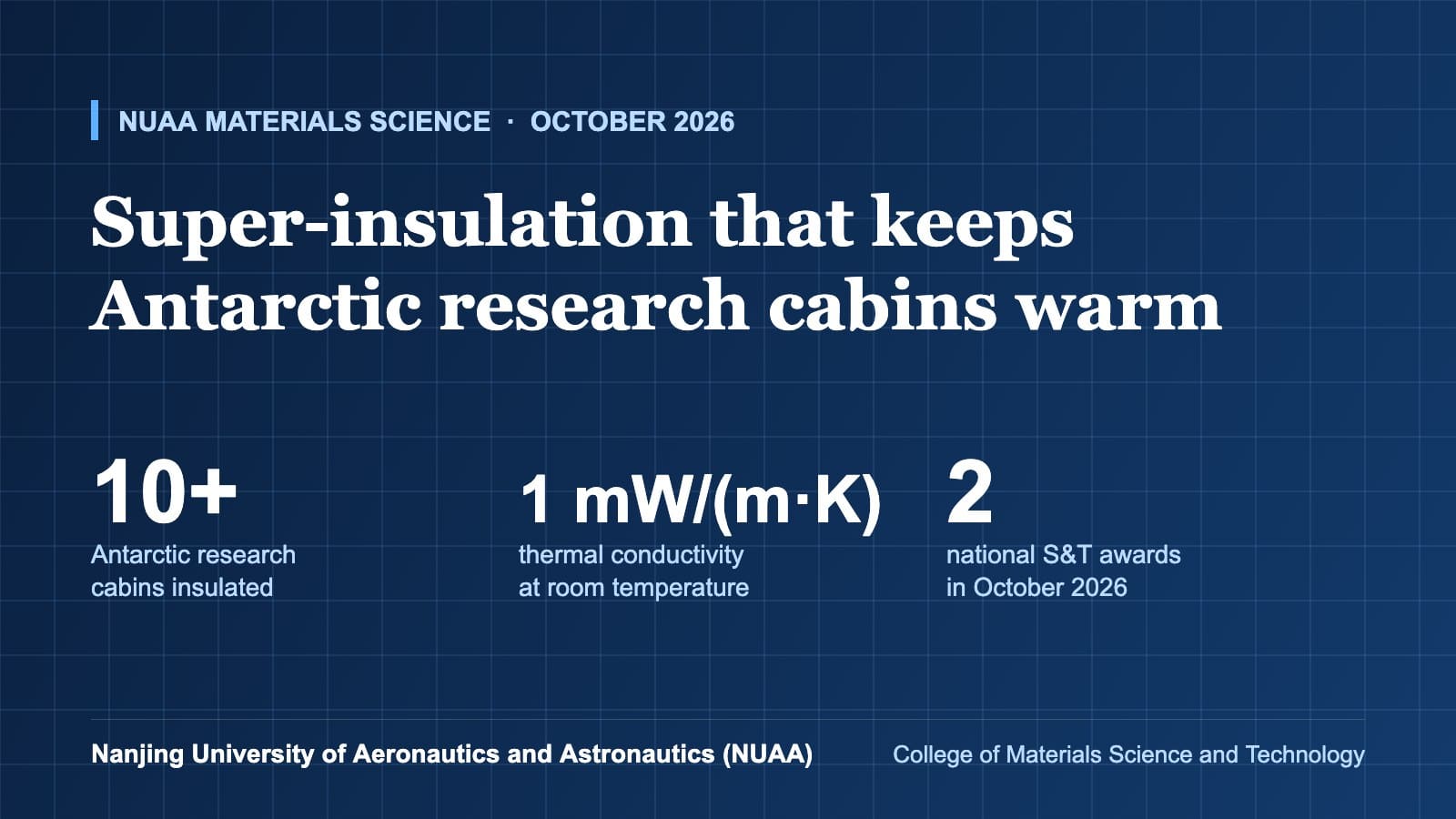
A super-insulation material developed at Nanjing University of Aeronautics and Astronautics (NUAA) is protecting researchers in Antarctica. The low-temperature, vacuum-state composite from Professor Chen Zhaofeng's laboratory has been installed in more than 10 research cabins at Chinese Antarctic stations, including Kunlun Station, and in October 2026 it helped win two national science and technology awards.
Kunlun Station sits 4,087 metres above sea level on the Antarctic plateau, where the recorded low is −83.1 °C. According to NUAA, the material keeps the cabins it protects at 22 °C inside, showing how materials research at NUAA is used in some of the harshest places on Earth.
Key facts
Team: Super-Insulation Composite Materials Laboratory, led by Professor Chen Zhaofeng, College of Materials Science and Technology, NUAA.
Material: a low-temperature, vacuum-state super-insulation composite with room-temperature thermal conductivity as low as 1 mW/(m·K).
Performance: according to the team, insulation 20–30 times better than traditional materials.
Use: more than 10 research cabins at Antarctic stations, including Kunlun Station.
Award 1 (22 October 2026): Special Prize, China Steel Structure Association Science and Technology Progress Award, for modular steel buildings for harsh environments, led by China Construction Third Engineering Bureau with NUAA as a partner.
Award 2 (23 October 2026): First Prize, Chinese Society for Composite Materials Science and Technology Progress Award, for super-insulation composites for polar research cabins, led by NUAA.
Earlier honour: a gold medal at the 51st International Exhibition of Inventions of Geneva.
How it works
Heat moves through air and solid materials. A vacuum-state composite removes most of the air inside the insulation, so very little heat can pass through it. With a thermal conductivity as low as 1 mW/(m·K) at room temperature, thin panels can do the work of much thicker conventional insulation — important for prefabricated cabins that must be shipped and assembled in Antarctica.
What this means for international students
NUAA's College of Materials Science and Technology works on materials that leave the laboratory and solve real engineering problems, from polar cabins to aerospace structures. Explore NUAA's programmes or find a supervisor in materials science.
Frequently asked questions
What is NUAA's Antarctic super-insulation material?
It is a low-temperature, vacuum-state composite developed by Professor Chen Zhaofeng's laboratory at NUAA. Its room-temperature thermal conductivity is as low as 1 mW/(m·K), and it insulates research cabins at Chinese Antarctic stations, including Kunlun Station.
What awards did the material win in 2026?
In October 2026 it contributed to a Special Prize from the China Steel Structure Association and won a First Prize from the Chinese Society for Composite Materials. It also earned a gold medal at the 51st International Exhibition of Inventions of Geneva.
Can international students study materials science at NUAA?
Yes. International students can apply for English-taught degrees at NUAA and, at master's and PhD level, choose a supervisor in the College of Materials Science and Technology.