A team at the College of Materials Science and Technology of Nanjing University of Aeronautics and Astronautics (NUAA) has reported a ruthenium–manganese catalyst that ran for more than 4,000 hours in acid. The paper, published online in Angewandte Chemie International Edition on 14 November 2026, targets longer-lasting electrolysers for green hydrogen.
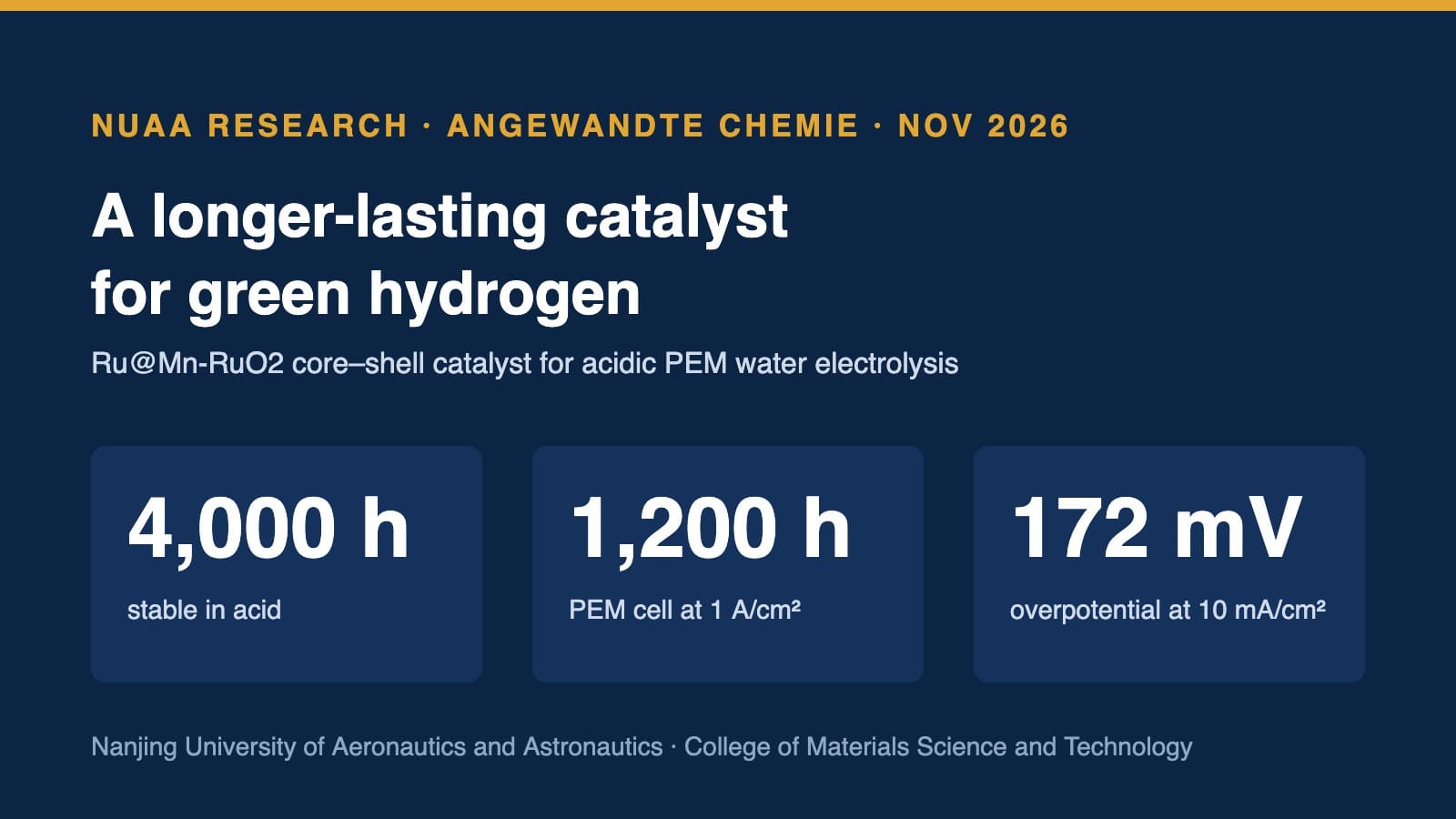
Why it matters. Green hydrogen is made by splitting water with renewable electricity. Proton exchange membrane (PEM) electrolysers, a compact type of water splitter, work in strongly acidic conditions that wear out most catalysts on the oxygen-producing electrode. Ruthenium-based catalysts are active but usually degrade quickly. The new catalyst needed only 172 mV of extra voltage (overpotential) to reach a current density of 10 mA/cm², and it kept a lab-scale PEM electrolyser running for 1,200 hours at 1 A/cm².
Key facts
Paper: "Activating Oxygen Radical Coupling via Ru–Mn Dual-Site Electronic Regulation for Durable Acidic Oxygen Evolution", Angewandte Chemie International Edition, published online 14 November 2026 (DOI 10.1002/anie.6281030).
First author Xiang Yijun and senior (last) author Li Linlin are from NUAA's College of Materials Science and Technology; 4 of the 13 authors are from NUAA.
Catalyst: a metallic ruthenium (Ru) core inside a manganese-doped ruthenium oxide (Mn-RuO2) shell, written Ru@Mn-RuO2.
Performance: 172 mV overpotential at 10 mA/cm²; stable for over 4,000 hours in acidic electrolyte; 1,200 hours of PEM electrolyser operation at 1 A/cm².
Partners: Beijing University of Technology, Southeast University, Anhui Normal University, the National Synchrotron Radiation Research Center in Hsinchu and the University of Pretoria, South Africa.
Funding includes the National Natural Science Foundation of China, the China Postdoctoral Science Foundation and the Natural Science Foundation of Jiangsu Province.
Stage: laboratory research; the catalyst has not yet been tested in a commercial electrolyser.
How it works
Splitting water releases oxygen at one electrode, and this oxygen evolution reaction is the slow, energy-hungry step. In most ruthenium catalysts, oxygen atoms are built up step by step on a single metal site, which costs energy and gradually damages the catalyst. According to the paper, the NUAA-led team paired ruthenium and manganese sites so that oxygen atoms on neighbouring sites can join directly. The authors call this a synchronised oxygen coupling mechanism.
The key is the boundary between the metal core and the oxide shell. According to the team, electrons rearrange across this boundary (a Schottky interface), which brings the ruthenium and manganese sites into closer electronic balance. This lets the two sites work together and helps the structure stay stable in acid.
What this means for international students
Clean-energy materials are a growing research area at NUAA's College of Materials Science and Technology, alongside aerospace materials. International students interested in electrochemistry, catalysis or hydrogen energy can explore related degree programmes or contact potential mentors through Find a Supervisor. Applications for the March 2027 intake are open: see how to apply.
Frequently asked questions
What did NUAA researchers develop for green hydrogen?
They developed a catalyst with a metallic ruthenium core and a manganese-doped ruthenium oxide shell for the oxygen-producing side of acidic water electrolysers. In lab tests it needed 172 mV of overpotential at 10 mA/cm² and stayed stable for more than 4,000 hours in acid, as reported in Angewandte Chemie in November 2026.
Is the new catalyst ready for industrial hydrogen plants?
Not yet. The results come from laboratory tests, including 1,200 hours in a lab-scale proton exchange membrane electrolyser at 1 A/cm². The team presents the work as a strategy for making ruthenium catalysts more durable. Scaling up and testing in commercial electrolyser stacks would be later steps.
Can international students study materials science and energy at NUAA?
Yes. NUAA's College of Materials Science and Technology admits international students to degree programmes, and research students can join laboratory teams working on energy materials. Students can browse programmes on the NUAA international admissions website and use the Find a Supervisor page to identify faculty whose research matches their interests.
Sources: Angewandte Chemie International Edition (DOI 10.1002/anie.6281030) · University of Pretoria repository record