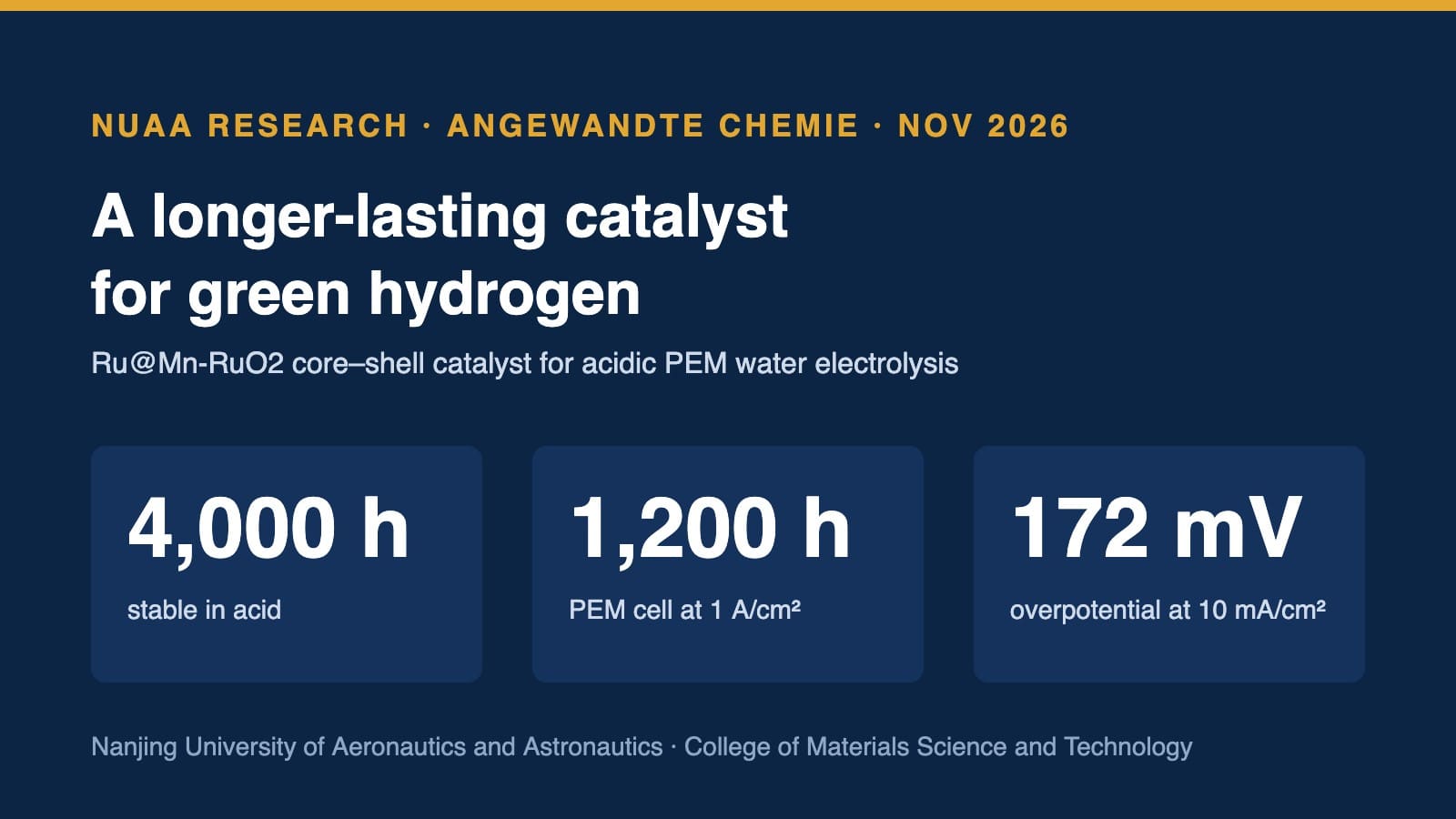
An NUAA-led team designed a core–shell catalyst that stays stable for over 4,000 hours in acid, aimed at longer-lasting PEM water electrolysers.
Researchers at NUAA's College of Materials Science and Technology have designed a catalyst that could make green hydrogen production more durable. Proton exchange membrane (PEM) electrolysers split water using renewable electricity, but their acidic conditions wear out the catalysts on the oxygen-producing electrode. The team built a core–shell catalyst, Ru@Mn-RuO2, with a metallic ruthenium core and a manganese-doped ruthenium oxide shell. Electron rearrangement at the core–shell boundary lets neighbouring ruthenium and manganese sites join oxygen atoms directly, which the authors call a synchronised oxygen coupling mechanism.
In lab tests, the catalyst needed only 172 mV of overpotential at 10 mA/cm², stayed stable for over 4,000 hours in acid and ran a lab-scale PEM electrolyser for 1,200 hours at 1 A/cm². First author Xiang Yijun and senior author Li Linlin are from NUAA; partners include Southeast University, Beijing University of Technology and the University of Pretoria. Published in Angewandte Chemie International Edition, November 2026 (DOI 10.1002/anie.6281030). Lab-stage research.