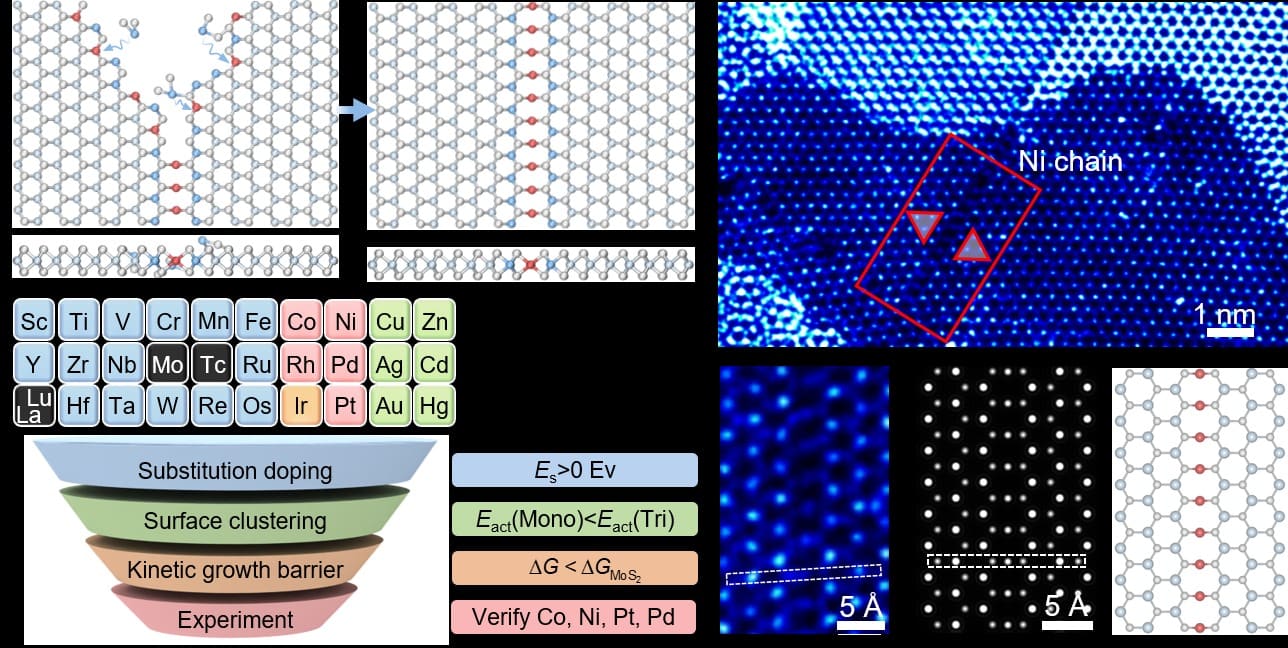
"A research team from Nanjing University of Aeronautics and Astronautics (NUAA), led by Academician Guo Wanlin, Professor Zhang Zhuhua and Associate Researcher Qiao Ruixi, in collaboration with Professor Liu Zheng of Nanyang Technological University (NTU), has achieved a breakthrough in fabricating single-metal-atom chains. The findings were published in Nature Communications."
A research team led by Academician Guo Wanlin, Professor Zhang Zhuhua, and Associate Researcher Qiao Ruixi of the Institute for Frontier Science at Nanjing University of Aeronautics and Astronautics (NUAA), in collaboration with Professor Liu Zheng of Nanyang Technological University (NTU), has achieved a significant breakthrough in the fabrication of single-metal-atom chains.
The findings, published under the title “Coherently Confined Single-Metal-Atom Chains in 2D Semiconductors,” were recently released online in Nature Communications.
Research background
One-dimensional (1D) nanostructures represent the smallest dimension that maintains efficient electron transport, and are deemed critical to the functionality and integration of nanoscale devices.
Single-metal-atom chains (SMACs), the ultimate manifestations of 1D structures, can confine electrons within an absolutely 1D space. This makes SMACs a unique platform for investigating quantum transport behaviors and correlation effects, including quantized conductance, opening up opportunities for cutting-edge applications in electronics, magnetism, and optics.
The challenge
Two typical approaches have been used to fabricate SMACs: top-down mechanical stretching for suspended SMACs, and self-assembly for supported SMACs. However, atomic chains made with these methods suffer from low yield and limited chain length. Moreover, most reported SMACs exhibit structural vulnerability and poor ambient stability.
The approach
The NUAA team proposed a computational protocol to identify transition metals capable of forming SMACs along mirror twin boundaries in two-dimensional metal dichalcogenides. Taking MoS2 as a prototypical example, thermodynamics and kinetics calculations indicate that Co, Ni, Rh, Pd, and Pt atoms can be enticed by the progressive formation of mirror twin boundaries to yield robust SMACs.
These findings are supported by successful experimental synthesis of Co-, Ni-, Pd- and Pt-based SMACs using a chemical vapor co-deposition method. The results lay a solid foundation for investigating exotic transport behaviors within extremely confined channels.
Full paper: https://doi.org/10.1038/s41467-025-60127-3
"