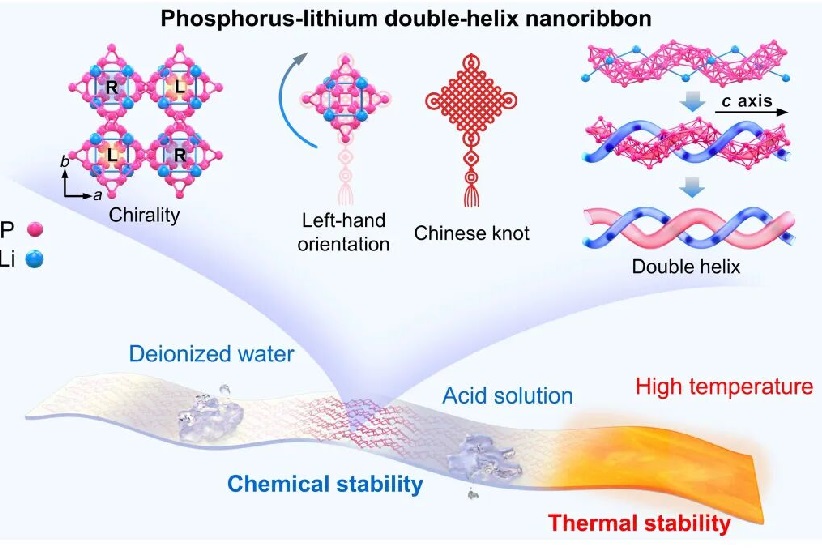
"A research team from Nanjing University of Aeronautics and Astronautics (NUAA), led by Guo Wanlin and Tai Guoan and working with Associate Professor Naoji Matsuhisa’s team at the University of Tokyo, has introduced a new material called “phosphorus-lithium double-helix nanoribbons.” Published in Science Advances, the material addresses the fragility of low-dimensional phosphorus materials and opens the way to applications in biomedical engineering and quantum technologies."
A research team from Nanjing University of Aeronautics and Astronautics (NUAA), led by professors Guo Wanlin and Tai Guoan, in partnership with a Japanese team steered by Associate Professor Naoji Matsuhisa from the University of Tokyo, has successfully introduced a new material called “phosphorus-lithium double-helix nanoribbons.”
The material addresses the inherent fragility of low-dimensional phosphorus materials, showing a general approach for stabilizing active low-dimensional materials and paving the way for applying phosphorus-based nanostructures in biomedical engineering and quantum technologies. The research findings were recently published in the journal Science Advances.
As a leader in the field of nanoscale physical mechanics, Guo’s team has long been dedicated to the structural design of low-dimensional materials and the study of multi-field coupling mechanisms. This breakthrough once again underscores NUAA’s international research prowess in this domain.
The challenge
Phosphorus-based materials are considered promising candidates for high-end optoelectronic devices due to their excellent conductivity and luminescence properties. However, their susceptibility to rapid oxidation and degradation in ambient conditions has posed a significant challenge to their practical application. Previous solutions, such as protective coatings, often compromised the materials’ inherent properties and failed to provide long-term stability under complex conditions.
The breakthrough
To overcome this challenge, the research team adopted an “atomic-level structural design” strategy. Through theoretical predictions and experimental validation, they fabricated a double-helix nanoribbon with alternating phosphorus and lithium atoms. The material exhibits a unique, highly ordered helical structure resembling a “Chinese knot,” and represents a rare example of a non-centrosymmetric inorganic double-helix crystal.
Electron microscopy analysis revealed that the nanoribbons are exceptionally thin yet structurally robust:
Thickness of just 3.11 nanometers (equivalent to five atomic layers)
Width reaching hundreds of nanometers
Length exceeding 10 micrometers
Stability and optical properties
The nanoribbons show superior stability. They maintain structural integrity in air at 225°C, remain unchanged after 30 days in water, and withstand immersion in strong acid for an hour without lattice degradation.
Their bandgap can be flexibly tuned, and they exhibit significant polarization-dependent optical responses, making them highly suitable for polarization-sensitive photodetection and nonlinear optical conversion.
Hydrogel composite and applications
Leveraging the nanoribbons’ exceptional water stability, the team integrated them with hydrogels to develop a composite hydrogel with high conductivity, self-healing properties, and efficient photothermal conversion. Potential applications include photothermal imaging, precision temperature control, photothermal therapy, and flexible bioelectronic devices, offering a novel platform for the development of smart medical materials.
“The core significance of this achievement lies in introducing the ‘double helix’ structural paradigm from biological systems into the field of inorganic low-dimensional materials,” said Guo, who is also an academician at the Chinese Academy of Sciences.
The research was completed with the contribution of NUAA doctoral graduates Hou Chuang and Lu Huan as first authors, with professors Guo, Tai and Matsuhisa serving as corresponding authors.
"