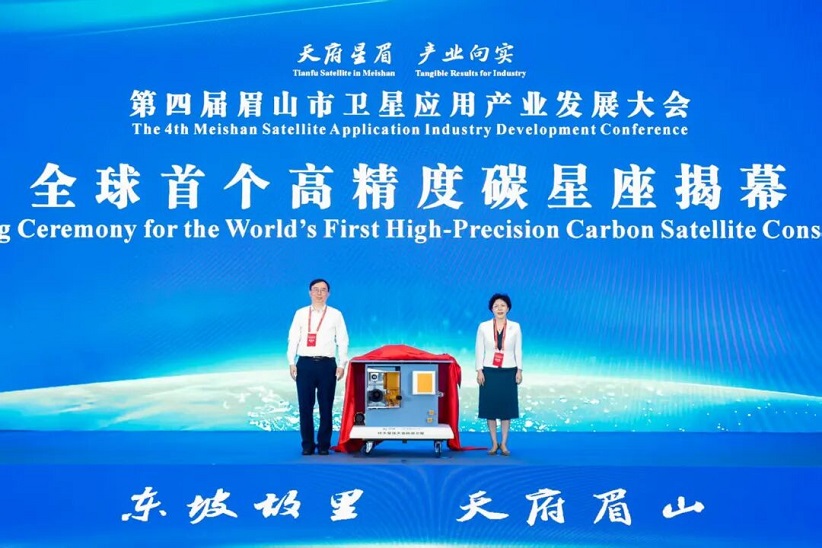
"Nanjing University of Aeronautics and Astronautics (NUAA), in partnership with Huantian Wisdom, has launched the Tianjian Constellation, billed as the world’s first high-precision carbon monitoring satellite constellation. The first satellite, Tianjian-1, is scheduled for launch in October, and the full 12-satellite constellation is expected to be completed by 2029."
Nanjing University of Aeronautics and Astronautics (NUAA) has launched the world’s first high-precision carbon monitoring satellite constellation, the Tianjian Constellation, in partnership with Huantian Wisdom.
The project was announced at the 4th Meishan Satellite Application Industry Development Conference in Sichuan province, where the constellation’s first satellite, Tianjian-1, also made its public debut.
Project roadmap
According to the project roadmap, Tianjian-1 is scheduled for launch in October. The full constellation, comprising 12 satellites, is expected to be completed by 2029, enabling the continuous, high-precision monitoring of carbon emissions on a global scale.
Why it matters
Accurate, real-time carbon emissions data is increasingly critical for governments to formulate low-carbon policies, support carbon trading mechanisms, and meet international climate commitments. Recognizing this need, NUAA launched research into a space-based carbon monitoring constellation in 2016.
Team and partnership
More than 30 researchers from the university have contributed to the project, bringing together their combined expertise in satellite systems engineering, aerospace remote sensing, optical engineering, artificial intelligence, and communications.
NUAA has led the overall system design, core technology development, and intelligent algorithm research, while its industry partner, Huantian Wisdom, is responsible for satellite operations and commercial deployment. Together, the two organizations have established a joint laboratory to accelerate the translation of cutting-edge aerospace research into practical space technologies.
Technical advances
To ensure the system can accurately measure emissions under real-world industrial conditions, the research team has pursued advances in three key areas: field monitoring, hardware precision, and intelligent data processing.
Field monitoring: Researchers have established ground-based carbon flux observation networks across a range of representative ecosystems to calibrate satellite observations.
Hardware reliability: The satellite and its instruments have undergone extensive reliability testing, simulating dozens of extreme space conditions, including rapid temperature fluctuations, intense vibration, and electromagnetic interference, to ensure reliable performance in orbit.