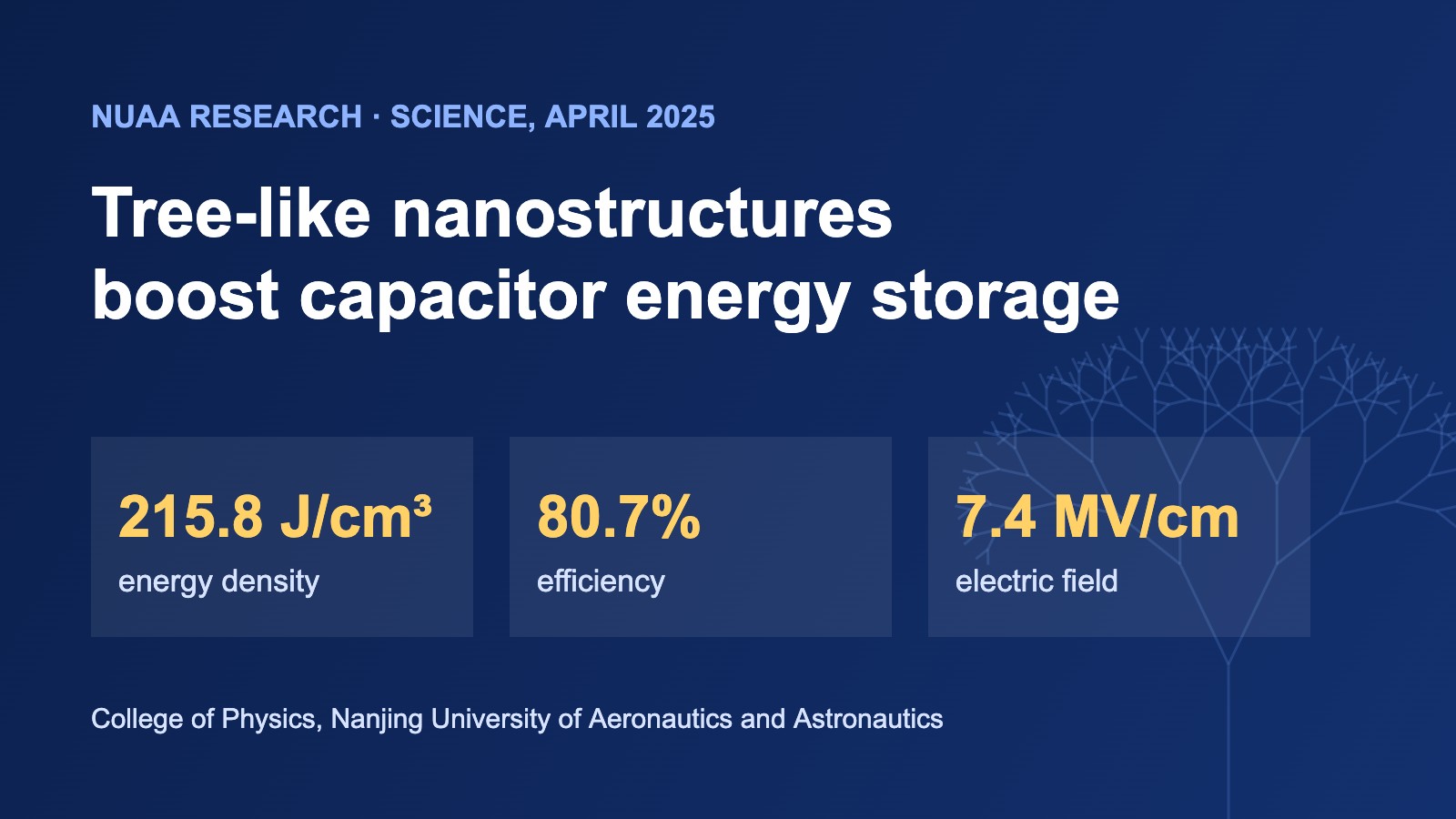
NUAA physicists designed self-assembled, tree-like nanoscale regions that let a thin-film capacitor store 215.8 J/cm³ at 80.7% efficiency, published in Science.
A team led by Professors Yang Hao and Li Weiwei of NUAA's College of Physics, working with Academician Nan Cewen of Tsinghua University, published Ultrahigh capacitive energy storage through dendritic nanopolar design in Science on 11 April 2025.
Dielectric capacitors store and release electrical energy very quickly, but packing in more energy usually raises losses or leads to breakdown. The team designed tree-like (dendritic) nanoscale polar regions that self-assemble inside an insulating material. According to the paper, this raises both breakdown strength and polarisation under high electric fields while keeping energy loss low.
In a lead zirconate titanate–magnesium oxide film (PbZr0.53Ti0.47O3–MgO), the team reached an energy density of 215.8 J/cm³ with 80.7% efficiency at an electric field of 7.4 MV/cm. The authors say the strategy can be applied generally to high-performance dielectric microcapacitors.
The co-first authors include Liu Yajing, who completed her PhD at NUAA in June 2024 and is now a postdoctoral researcher in the College of Physics. Partners included the Max Planck Institute and the University of Cambridge.
Source: NUAA News